

Health & Everyday Science · 7-minute read
Why That Clean-Mouth Feeling Never Lasts
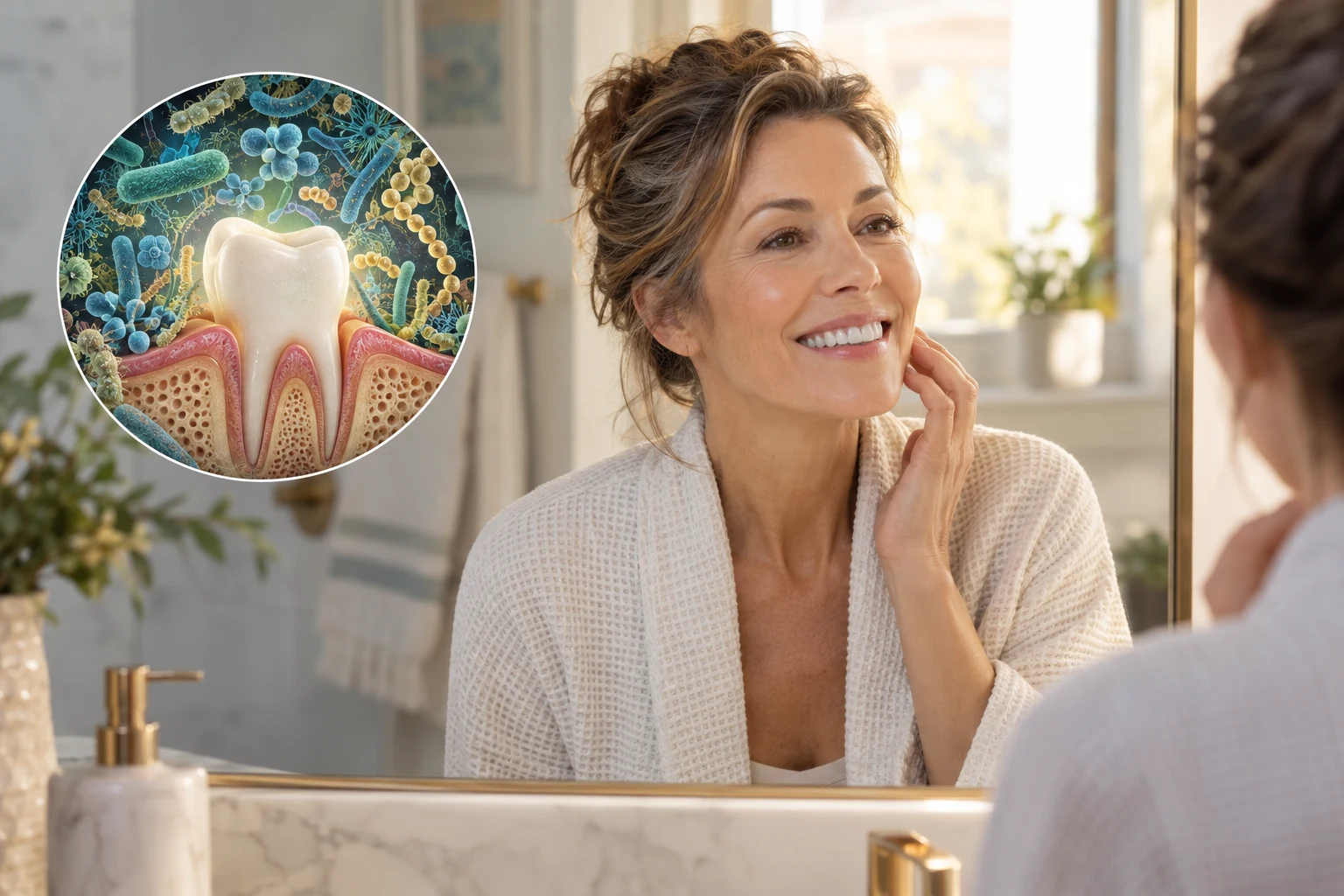
You brush, rinse, and start clean. Then the feeling fades. A growing area of oral-health research suggests the missing context may be the living ecosystem inside your mouth.
Morning mint. Smooth teeth. That just-brushed feeling. Then lunch happens. Coffee happens. By midafternoon, the clean feeling is gone. You catch a stale taste, your mouth feels dry, and one thought hijacks the conversation: Can they smell my breath?
That question changes how people behave. You lean back. Turn your face slightly. Reach for another mint before speaking close to someone. Breath is personal because other people may notice it before you can be certain—and almost nobody will tell you.
The usual response is predictable: brush harder, rinse longer, buy something stronger. It may help for a while. Then the same stale, uncomfortable feeling finds its way back.
That cycle is frustrating because it treats the mouth like a countertop: scrub it clean and the job should be finished. But your mouth is not a lifeless surface. It is a warm, constantly changing habitat populated by organized communities of microorganisms.
Researchers call this the oral microbiome. Once you understand it, the question changes from “How do I wipe everything out?” to “What helps a healthy oral environment stay on track?”
That is why oral probiotics have moved from a niche research idea into daily-care products. Instead of trying to make the mouth feel freshly scrubbed for a few more minutes, they take aim at the environment underneath the routine. They do not replace brushing, flossing, or dental care. They explore a different part of the picture.
Does your mouth feel stale by midday?
Stop wondering whether other people notice your breath.
If that clean feeling disappears long before the day is over, see the daily approach focused on the environment inside your mouth—not just another surface clean.
Click to Learn MoreWhat changes after you brush
Your mouth starts changing again almost immediately.
Every sip, snack, dry spell, and night of mouth breathing changes the conditions inside your mouth. Saliva moves. Acidity shifts. Microbes attach to different surfaces and interact with one another. The tongue, gumline, cheeks, and spaces between teeth are not one uniform environment.
Age, diet, tobacco exposure, medications, and underlying conditions can influence that environment too. This is one reason two people can follow similar routines and still have very different experiences.
Brushing and cleaning between teeth remain essential. They remove debris and disrupt buildup. But they are moments in a 24-hour living system—not a permanent reset button.
The surprising part
Most of the microbes in your mouth are not the enemy.
The word “bacteria” usually sounds like something to destroy. Oral-microbiome research tells a more interesting story. Scientists have mapped structured microbial neighborhoods on the tongue, teeth, gums, cheeks, and between teeth.
“Most of these microbes promote health, and only a small fraction cause disease.” — National Institute of Dental and Craniofacial Research
That does not mean hygiene products are harmful, or that you should stop using them. It means the healthiest goal is not a sterile mouth—because a sterile mouth is neither realistic nor desirable. The practical goal is a well-cared-for environment in which ordinary protective systems can do their work.
That shift—from total elimination to thoughtful support—is what made oral probiotics an obvious subject for researchers and supplement makers to explore.
A different kind of oral-care product
Why a chewable instead of another stronger rinse?
Oral probiotics take a different route. They use selected live microorganisms in lozenges, chewables, or similar formats intended to spend time in the mouth. The aim is not to replace basic hygiene. It is to add targeted strains to the routine.
The concept is legitimate enough to study, but it is not a magic answer. Results depend on the strain, the product, the person, and the outcome being measured. Recent reviews describe some encouraging findings alongside conflicting results and unanswered questions.
That is the honest limit of the science. The practical question is simpler: if you are curious about trying an oral probiotic, what exactly are you getting?
One formula built around this approach is ProDentim, a once-daily chewable that combines selected probiotic strains with several supporting ingredients. Here is what its published label actually contains.
A once-daily alternative
See what makes this different from another toothpaste or rinse.
Look inside the probiotic strains, supporting ingredients, and chewable format behind this different approach to daily oral care.
Click to Learn MoreWhat you are actually considering
Inside the once-daily chewable.
The published label lists 3.5 billion probiotic organisms plus supporting nutrients. Highlighted strains include Lactobacillus paracasei, Lactobacillus reuteri, and Bifidobacterium lactis BL-04.
The formula also lists inulin, malic acid, tricalcium phosphate, and peppermint. The directions call for slowly chewing one tablet each morning, making it a simple addition rather than a replacement for the routine you already have.
The label tells you what is inside; it cannot tell any individual exactly what experience they will have. The independent research cited here concerns oral probiotics as a category, not this finished formula. Compare the ingredients, current price, guarantee terms, and your own expectations before deciding.
- Format
- Chewable supplement
- Guarantee period
- 60 days
- Current bundles
- 2, 3, or 6 bottles
Prices, bonuses, shipping terms, and guarantees can change. Confirm every detail on the official page before ordering.
Who this is—and is not—for
You do not need another product just because it is new.
If you are completely satisfied with your current routine, there may be no reason to change it. But if the clean feeling never seems to last—and you are interested in supporting the oral environment rather than simply adding a harsher rinse—an oral probiotic may be worth investigating.
Persistent pain, bleeding, swelling, sores, or loose teeth are different. Those concerns deserve professional attention, not a supplement experiment. Anyone who is pregnant, nursing, immunocompromised, managing a serious condition, or taking medication should ask a qualified professional before adding a probiotic.
For everyone else, the choice is straightforward: keep the proven basics, read the actual label, understand the limits, and decide whether this different approach earns a place in your morning routine.
The bottom line
Brushing still matters. It may not be the whole story.
You already know what happens when you repeat the same routine. If the fresh feeling keeps disappearing and the breath anxiety keeps returning, there is no reason to keep doing exactly the same thing without exploring another option.
Click to Learn More